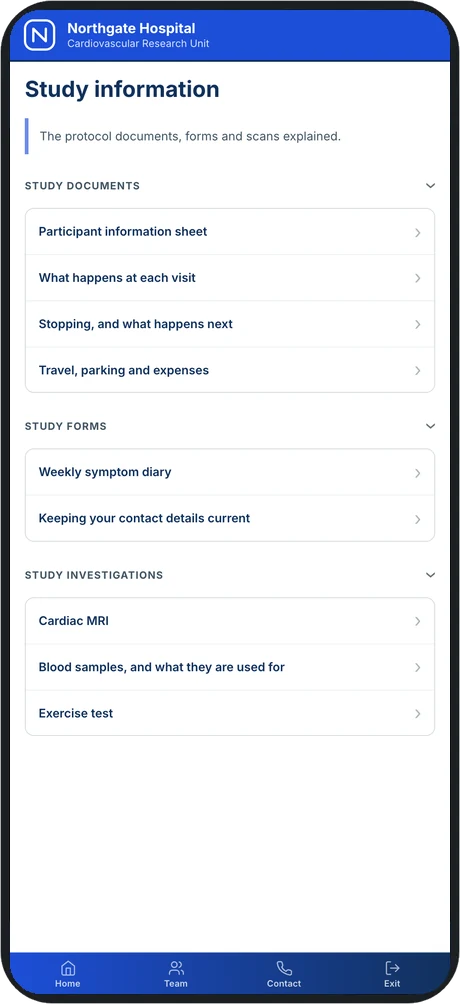
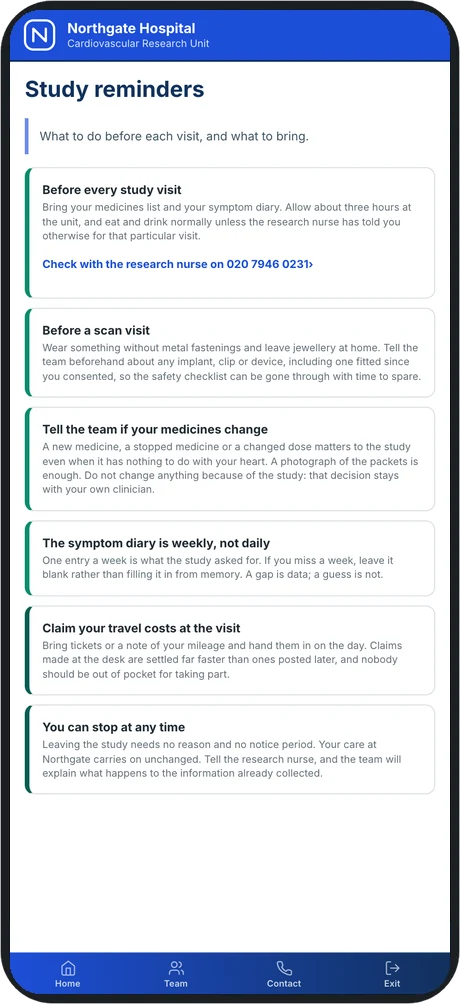
One branded place for the study: protocol documents, the visit schedule, the team, and the number that reaches the research nurse. A link or a QR code. No app, no participant login.


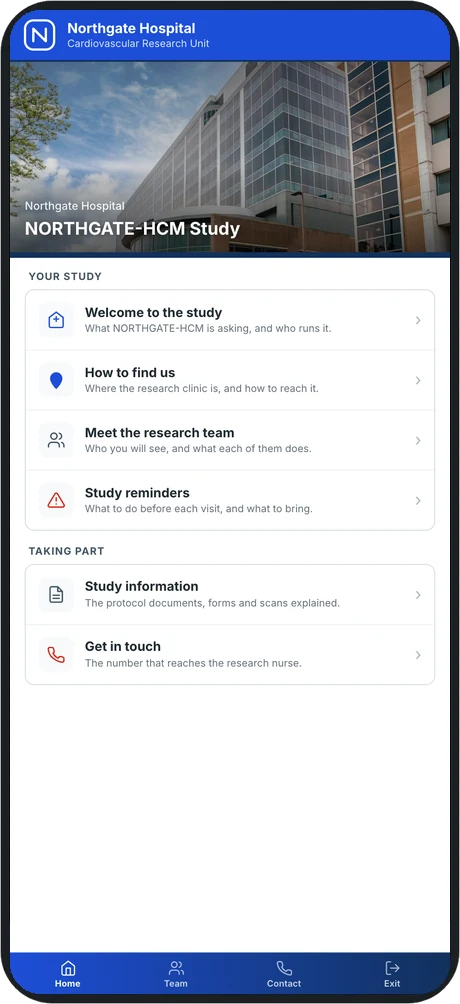
They leave because the practical side got hard. The consent pack went into a drawer in week one, the visit schedule lives in an email thread, and nobody is sure which number reaches the research nurse.
No protocol amendment fixes that. It is an information problem, and it belongs on the phone in their pocket.
Configured per study in the same admin, with no code changes, and branded as the study rather than as us.
PatientMemo runs no surveys or questionnaires of its own, and holds no participant responses. Where a study collects answers, the app links out to the study’s own form, on its own tooling.
So a deployment adds no new processor to the study’s data flow, and no new route out for identifiable data.
A unit rarely runs one study. Any number deploy from one platform, so a second study is a content exercise rather than a second procurement.
Own logo, colours and banner text, so a sponsor-facing study and an investigator-led one look like what they are.
Every request is scoped to the organisation that owns it, and a test suite tries to cross that boundary and must fail.
Your team writes every word participants read, and you control who publishes it.
The sites, the team and the content. No code changes, no integration.
Its own URL, for the consent pack, the visit letter or the poster in the waiting area.
Amendments and changed contacts are edited directly, so participants see what the study currently says.
Read the full FAQ, or send the question your team is stuck on.
The same platform deploys as a clinical service companion.
Run it for one study, with your own protocol, sites and study team in it rather than an example, and see what it changes.
Request demo