For NHS providers

A patient information platform for NHS services.

One branded place for what your patients actually need: your care team, your clinic details, your explainers and the right contact at the right moment. A link or a QR code. No app, no patient login.


Someone reading their service’s information on a phone
Someone looking something up on a phone in hospital

What your service is actually competing with.

Not another platform. Four things that already exist, each going out of date on its own schedule.

The leaflet

Right the day it was printed. Reprinting is a budget line, so the wrong version stays in the rack.

The trust website

Written for the organisation, not this service. Several clicks deep, awkward on a phone.

The conversation

The same questions again at every appointment. Clinic time is the most expensive way to deliver information that never changes.

The search

What they read at eleven at night, from whoever ranks highest, with nobody from your service in the room.

What an NHS service publishes with it.

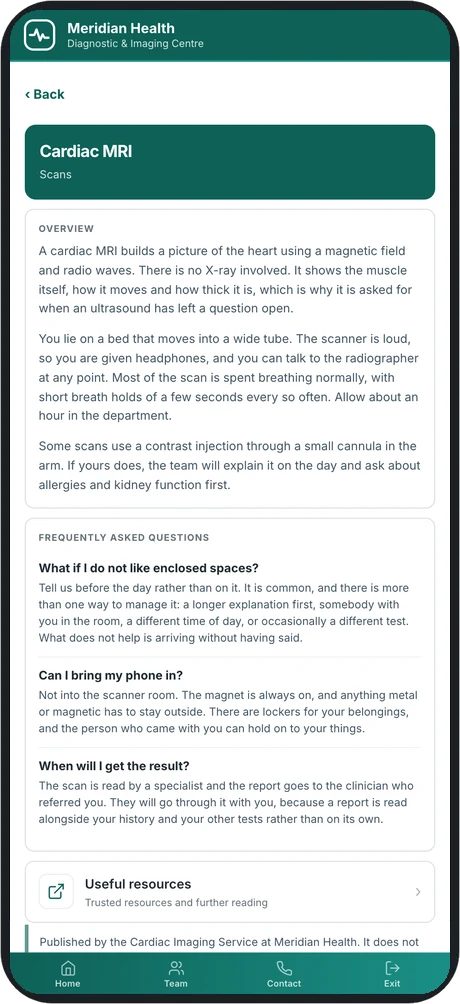
Written by your clinical team, carrying your branding, edited in the admin without a developer.

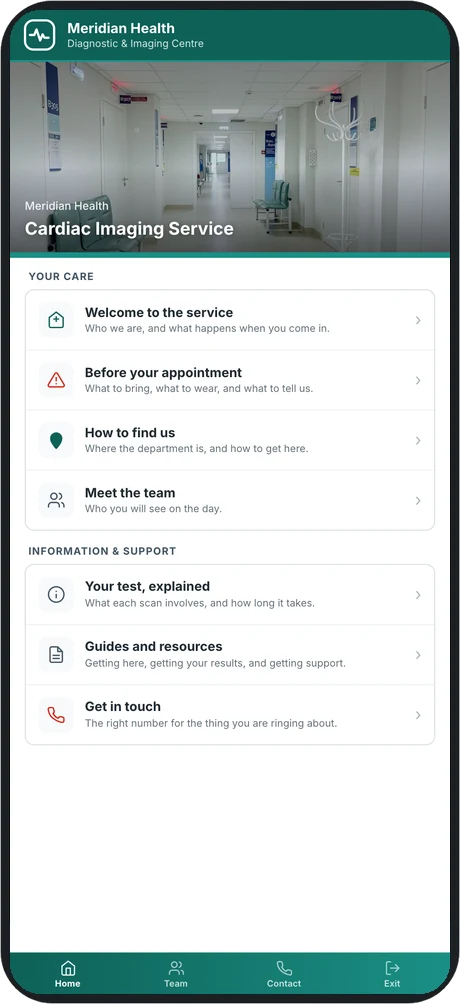
A service home screen branded as Meridian Health, listing the welcome, appointment preparation, the department location, the team, the test explainers and contacts A cardiac MRI explainer with an overview and frequently asked questions, written by the service

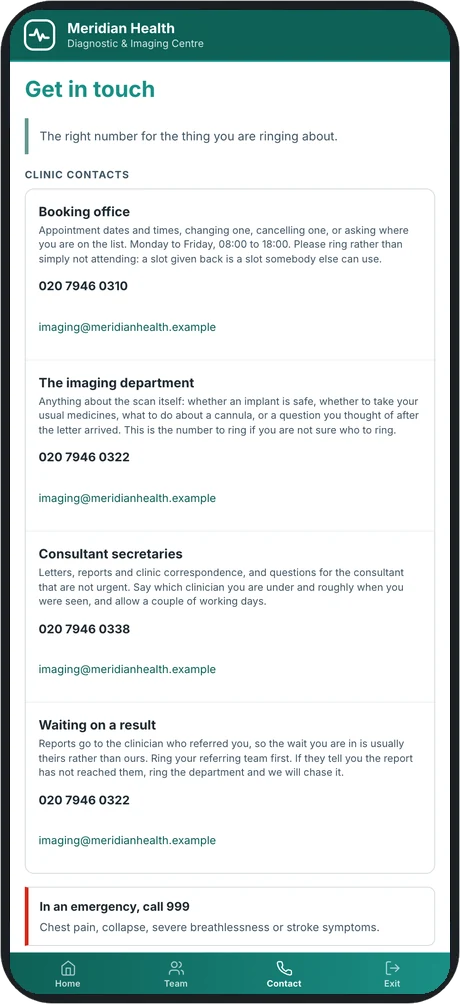
Patients often do not know whether to ring booking, imaging, the nursing team or a secretary. So they ring the wrong one, or nobody. Making the correct route obvious is the least glamorous thing on this page and usually the first thing a service notices.

Each contact says what it is for, so the choice happens before the call.

A contacts screen listing the booking office, the imaging department, consultant secretaries and who to ring about a result, with emergency guidance below

Live in days, not months.

No bespoke development and nothing to integrate with. Setup is content work, done by the people who know the content.

  1. Create the service in the admin

    Your clinics, clinicians and content. Branding applies per service automatically.

  2. Hand patients a QR code or a link

    Its own URL, for the appointment letter, the clinic wall or the discharge summary. It opens on any device.

  3. Update it whenever something changes

    Your team edits directly, and you control who can publish.

The questions your governance team will ask.

The release is deliberately low-data and low-integration, so most of what makes an IG review slow does not apply.

No patient-identifiable data

No names, identifiers, records or results. It publishes what your service already gives out, so there is no record set to assess.

No patient login

A link or a QR code. No account, no password, no credential to lose.

Content stored in the UK

Content and uploaded files sit in a UK region (London), delivered from a content network, as any website is.

Communication runs one way

Service to patient, and it stops there. No reply channel, no message box, no upload.

Your surveys stay yours

PatientMemo runs no surveys and stores no responses. The app links out to your own form, on your own tooling.

No connection to your EPR

No EPR connection and no integration to go live. One organisation cannot see another’s content, and a test suite tries to cross that boundary and must fail.

Read the full FAQ, or send the question your team is stuck on.

What it is not.

Every line describes the current release. Planned is not shipped, and planned is not on this page.

Running studies as well as clinics?

The same platform deploys as a research participant companion, through the same admin.

Pilot PatientMemo at your trust.

Run it for one service, with your own team, clinics and explainers in it rather than an example, and see what it changes.

Request demo